

contents
For the first several years of generative AI, access was the advantage. Enterprises raced to gain access to the best models, secure scarce GPU capacity, build experimentation environments, and put AI into the hands of employees. The objective was largely to learn what these technologies could do, where they could create value, which use cases were practical, and which were still several years away.
That phase was necessary, but the next phase will require a different discipline. Access to powerful models and compute will remain important, yet the organizations that create the greatest value from AI will increasingly be those that understand its economics. That means knowing which workloads deserve premium infrastructure, matching models and compute to the value of the task, understanding utilization and inference costs, managing architectural dependencies, and connecting those decisions to measurable business outcomes.
Recent reports of higher prices for NVIDIA-based systems provide a useful window into this shift. The important story for CIOs extends well beyond the price of a GPU. Memory, power, cooling, networking, data center capacity, and increasingly financing are all becoming meaningful parts of the economics surrounding AI infrastructure. As these elements become more interconnected, enterprise AI starts to look less like a discrete technology purchase and more like an economic system that CIOs must actively manage.
That interconnectedness is becoming increasingly visible across the AI ecosystem itself. The relationships among model developers, chipmakers, cloud providers, infrastructure companies, and investors increasingly blur the traditional boundaries between supplier, customer, partner, and investor. The result is an AI economy in which capital, capacity, technology, and demand continually reinforce one another.
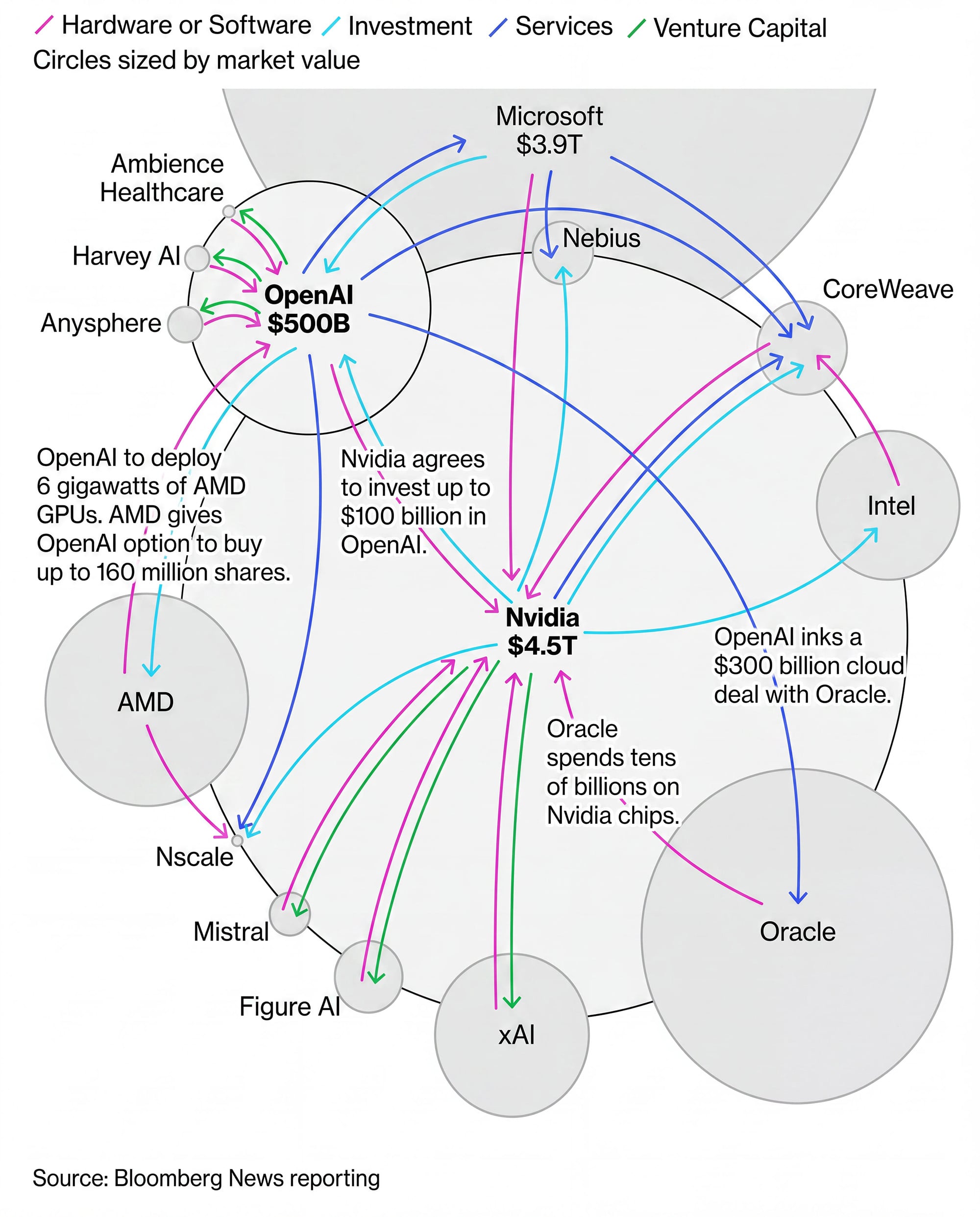
AI economics extend far beyond the GPU
The AI ecosystem is becoming increasingly intertwined. Chipmakers, model developers, cloud providers, infrastructure companies, and investors are connected through a growing mix of customer relationships, partnerships, investments, and capacity agreements. That web helps explain why changes in AI pricing rarely stay contained to a single company or component. NVIDIA has built an extraordinary competitive position, but its pricing exists within this larger system of dependencies. Enterprises, cloud providers, model developers, infrastructure companies, and technology vendors have optimized significant parts of their AI ecosystems around its technology, which naturally creates considerable pricing power. At the same time, cost pressures extend across the broader AI supply chain.
Advanced memory is increasingly important and constrained. Power availability has become a strategic consideration. High-performance networking matters more as clusters grow, cooling requirements are increasing, data center capacity remains limited in many markets, and the capital required to build this infrastructure is enormous. For the CIO, the origin of any particular cost increase matters less than its cumulative effect because every component ultimately contributes to the economics of the workload.
This makes AI infrastructure different from many traditional enterprise technology categories. A software platform might have a relatively understandable subscription model, a storage environment can often be forecast using capacity and growth, and a conventional application may have a fairly stable operating profile. AI consumption, by comparison, can move dynamically across models, tokens, accelerators, clouds, regions, applications, users, agents, and infrastructure layers.
CIOs therefore need visibility beyond the purchase price of infrastructure. The increasingly important question is the end-to-end cost of producing an AI-enabled business outcome and whether that cost is justified by the value the enterprise receives in return.
Volatility should become a planning assumption
Enterprise technology leaders are accustomed to an assumption that has held remarkably well over time: computing gets cheaper. AI is challenging that assumption, at least in the near term.
Capacity will eventually expand, competition will increase, models will become more efficient, alternative accelerators will mature, and software optimization will reduce the compute required for many workloads. Those forces should improve AI economics over time, but the timing is much harder to predict.
For at least the next 12 to 18 months, CIOs should prepare for continued volatility as enormous amounts of capital pursue constrained capacity across GPUs, memory, power, networking, and data centers. Business cases built around an assumption of rapid hardware deflation could therefore prove difficult to sustain.
That should change enterprise planning. CIOs should build scenarios that allow AI infrastructure costs to remain elevated through 2027, and investments that only generate an attractive return if compute becomes dramatically cheaper deserve additional scrutiny. Economic discipline becomes more important as costs rise because enterprises need a clearer understanding of which workloads deserve which resources, how much infrastructure is actually being utilized, and whether optimization could create more value than additional capacity.
This pressure can be constructive. It forces a stronger connection between infrastructure consumption and business outcomes and encourages enterprises to manage AI with the same financial rigor applied to other strategic investments.
Architectural optionality becomes economic leverage
The natural reaction to rising NVIDIA prices will be to explore alternatives, and enterprises should. The greater opportunity is to build architectural optionality into the environment so that the organization maintains choices as technology, pricing, and availability evolve.
CIOs should understand where AMD, hyperscaler silicon, specialized accelerators, alternative model architectures, and different infrastructure providers can support particular workloads. They should know where switching is practical, where it introduces material engineering complexity, and where the performance benefits of premium infrastructure genuinely justify the additional cost. Software ecosystems, engineering requirements, workload characteristics, and switching costs all matter alongside the sticker price of the hardware.
Optionality creates several forms of economic value. It provides negotiating leverage, creates resilience when capacity is constrained, allows the enterprise to take advantage of technological improvements, and reduces the likelihood that architectural decisions made during a rapidly evolving market become expensive long-term dependencies.
Enterprises do not need multiple architectures for every workload. They do need to understand their alternatives before circumstances force the decision. The strongest enterprise AI architectures will have enough flexibility to evolve as both the technology and its economics change.
Workload placement becomes a core CIO capability
One of the most important changes ahead will be the way enterprises think about AI infrastructure itself. For most organizations, owning the most sophisticated AI infrastructure available is unlikely to provide competitive differentiation on its own.
Hyperscalers and specialized infrastructure providers can aggregate demand, negotiate capacity, optimize utilization, and absorb operational complexity at scales that an individual enterprise often cannot. For some workloads, consumption-based infrastructure will therefore make considerably more economic sense. Other workloads may justify dedicated infrastructure because of utilization, latency, security, sovereignty, control, or predictable demand, while still others may run perfectly well on less expensive accelerators.
The answer will increasingly vary workload by workload, which makes workload placement one of the most important capabilities CIOs can develop around AI. Training and inference already have very different economics. Experimentation and production have different utilization profiles. A customer-facing real-time application may have requirements that bear little resemblance to an internal knowledge assistant, while an autonomous agent executing thousands of repetitive tasks may need a completely different model strategy from an application supporting a handful of highly complex decisions.
Treating all of this simply as “AI compute” obscures enormous economic differences. A more sophisticated approach is to determine what level of intelligence, performance, reliability, latency, control, and security each workload actually requires, and then match the infrastructure accordingly.
The winning enterprise AI architecture will be the one that matches the right model, compute, and infrastructure to the economic value of the workload.
The most expensive model should not become the default
The same principle applies to model selection. During the experimentation phase of generative AI, organizations understandably gravitated toward the largest and most capable models. When teams are discovering what a technology can do, maximum capability is attractive. At enterprise scale, however, that approach can become unnecessarily expensive.
Many tasks simply do not require frontier-model intelligence. Routing, smaller models, caching, quantization, and other optimization techniques can reduce the amount of compute required to deliver a useful outcome. Improvements in model selection, utilization, routing, and caching may ultimately create more economic value than simply purchasing additional infrastructure.
A sophisticated enterprise AI environment may therefore use multiple models based on the complexity, risk, and value of a request. Straightforward tasks can be handled by smaller, less expensive models, while more difficult reasoning can escalate to more capable systems. Frequently repeated information can be cached rather than regenerated, and workloads can be routed dynamically based on cost, latency, risk, or performance.
The result is better economics, and better economics make AI substantially easier to scale across the enterprise.
Scarcity can improve AI decision-making
There is an opportunity hidden inside rising AI infrastructure costs because scarcity forces discipline. The early phase of generative AI needed broad experimentation; enterprises could not build sophisticated AI strategies without first learning how the technology behaved in practice. As AI moves deeper into production, the questions can become much more demanding.
CIOs should increasingly understand what an inference costs, how much of the infrastructure is actually utilized, which model a workload truly requires, and how often premium compute is being used when something less sophisticated would work. They should also be able to connect those technical decisions to business questions: What outcome does the workload produce? How valuable is that outcome? Does the value justify the resources being consumed?
Those questions represent progress because they move AI away from experimentation budgets and toward the economic scrutiny applied to other strategic enterprise investments. That does not mean every AI initiative needs to demonstrate immediate cost savings. AI can create revenue, improve customer experiences, accelerate product development, reduce risk, increase workforce capacity, improve decisions, or enable entirely new business models. But as AI scales, there should be an increasingly visible relationship between the value being created and the resources being consumed.
If compute becomes 15%, 20%, or 30% more expensive, the business case becomes more important. CIOs will need to understand cost per inference, utilization, model efficiency, and ultimately the business outcome being produced by that infrastructure. That pressure can help enterprises distinguish experimentation from scaled investment and concentrate resources on AI initiatives capable of producing meaningful business outcomes.
Higher prices will accelerate innovation
CIOs should also avoid assuming that today’s AI economics are permanent because technology markets respond aggressively to incentives. NVIDIA’s market position and margins create an enormous economic invitation for competitors. Higher prices strengthen the business case for AMD, custom hyperscaler silicon, specialized accelerators, alternative architectures, more efficient models, and software techniques capable of producing comparable outcomes with substantially less compute.
Competition may take time to materially change enterprise buying decisions, particularly given the size of the existing NVIDIA ecosystem and the complexity involved in switching. But the incentive is unmistakable. Scarcity creates pricing power, pricing power attracts competition, and competition drives innovation that eventually gives enterprise buyers more choices.
CIOs should therefore make today’s decisions with an eye toward tomorrow’s options. Long-lived architectural dependencies deserve additional scrutiny in a market evolving this quickly, and enterprises that preserve flexibility will be better positioned to benefit as new chips, models, providers, and efficiency techniques reshape the economics.
Five moves CIOs can make now
The economics of AI will continue changing, and CIOs do not need perfect predictions about where GPU prices, model costs, or infrastructure markets ultimately settle. They need an operating model capable of adapting as those economics change.
1. Budget conservatively
Build AI business cases that remain attractive even if infrastructure costs remain elevated, rather than relying on rapid price declines to make the economics work.
2. Create architectural optionality
Understand alternative accelerators, infrastructure providers, clouds, and model architectures before circumstances force a migration. Never lock in your data, inference, and context without the ability to own it and separate it from the model, provider, or vendor.
3. Segment workloads
Treat training, inference, experimentation, production, agents, and other major workload classes according to their distinct requirements and economics.
4. Optimize before adding capacity
Improve model selection, routing, caching, utilization, and architecture before assuming that additional infrastructure is the answer.
5. Measure AI in business terms
Track the relationship between the resources consumed and the outcomes created, whether that value comes through revenue, productivity, customer experience, risk reduction, innovation, or another strategic objective.
These disciplines become increasingly important as AI moves from hundreds of experiments to thousands or millions of interactions embedded throughout the enterprise. The more pervasive AI becomes, the more important economic management becomes alongside technical capability.
Economics will separate the leaders
The first era of enterprise generative AI was defined largely by access. Competitive advantage came from getting the models, securing compute, experimenting quickly, and putting new capabilities into the hands of employees. Those advantages still matter, but the next era adds another dimension: the ability to consume intelligence economically.
The leaders will know when the largest model is worth using and when it is unnecessary. They will place workloads deliberately, preserve architectural flexibility, continually improve utilization, and understand the full cost of AI infrastructure rather than focusing only on the price of a GPU or a token. Just as importantly, they will connect those choices to the business value being created.
That creates a fundamentally different source of competitive advantage. The winners in enterprise AI will be the companies that generate the greatest value from every unit of compute, every model call, and every dollar invested.
this article was about
related insights

September 26, 2026
Category: technology
Tags: ai • data • enterprise strategy • saas • technology strategy
6 minute read